| Learn about the 2021 heat dome's ecological impacts, become a quantum expert and enter our Science Rendezvous alumni contest to win a LEGO set! |
| How plants, animals and ecosystems were impacted by the 2021 B.C. heat dome |
|
The 2021 heat dome in B.C. may have only lasted a week, but it had a major impact on plants, animals and ecosystems across the province. A new study led by UVic ecologist Julia Baum examined the heat dome’s ecological impacts, looking at species and organisms from seagrass to mussels to baby birds and caribou. While some species did come out as winners, over ¾ of plants and animals were negatively impacted. The most heartbreaking impact? Baby birds trapped in their overheating nests died or suffered injuries as they jumped out trying to escape the heat.
|
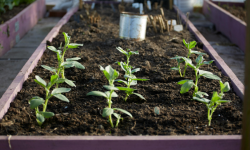 Plants growing in a garden bed. Plants growing in a garden bed. |
| The secrets in your gardens |
| Spring is here, it’s starting to get warmer, and it’s time to start thinking about your garden! When it comes to plants and gardening, there’s always so much to learn—so we sat down with UVic forest biologist Barbara Hawkins to get some of her favourite facts about your garden and backyard. Whether you’re looking to better understand nature or just want to have a new fun fact in your back pocket, we’ve got you covered! |
|
LEARN THE SECRETS
|
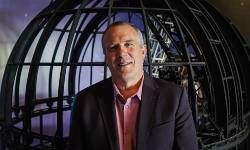 Luc Simard. Luc Simard. |
| Transforming astronomy in Canada |
| The moment that seven-year-old Luc Simard (PhD in Physics, 1996) peered through a neighbour’s small backyard telescope, he became enamoured with the universe beyond our planet. Decades later, Simard is the Director General of the Herzberg Astronomy and Astrophysics Research Centre at the National Research Council of Canada and has helped shape Canada’s role in some of the most ambitious astronomy projects ever undertaken. Simard is also a recipient of a 2026 Presidents’ Alumni Award. |
| READ LUC SIMARD'S STORY |
|
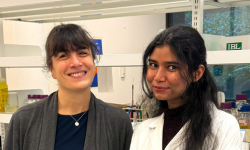 Researchers Nicole Templeman and Faria Athar. Researchers Nicole Templeman and Faria Athar. |
| The connection between menopause and insulin levels |
| Hot flashes, night sweats, and cold sweats affect around 75 per cent of women during the menopausal transition. New research from UVic biologist Nicole Templeman has found that a woman’s insulin levels in midlife are linked to the timing and duration of these symptoms. Higher insulin levels at age 47 were associated with longer durations of hot flashes and cold sweats. This finding fills in some of the gaps in understanding why the severity of menopause symptoms varies for different women, while also raising the question of whether lifestyle interventions that lower insulin levels might forestall these unwanted symptoms. |
| LEARN MORE ABOUT THE RESEARCH |
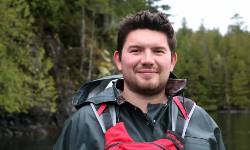 Jared Dick. Jared Dick. |
| The path from summer science camp to fisheries biologist |
| For alumnus Jared Dick, a science summer camp sparked an interest that led to an education and career in STEM. A member of the Hupacasath First Nation, Jared joined Uu-a-thluk, the Fisheries Department of the Nuu-chah-nulth Tribal Council, as an intern, collecting data on salmon after his first year—and for the subsequent three summers too. The experience shifted his career aspirations (he’d previously wanted to be a teacher), and after graduating, he continued his career with Uu-a-thluk, ultimately becoming a regional fisheries biologist. Today, Jared is back at UVic as a master’s student, examining how Nuu-chah-nulth perspectives can inform a federal Chinook salmon rebuilding plan. |
| FOLLOW JARED'S PATH |
|
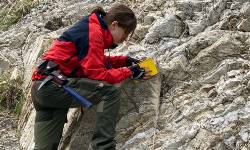 Stacy Edmonsond conducting field work. Photo credit: Kai Tawil-Morsink. Stacy Edmonsond conducting field work. Photo credit: Kai Tawil-Morsink. |
| A new view of the carbon cycle billions of years ago |
| When you combine field geology with statistical modelling, you can end up with a new view of the chemical reactions happening on the ocean floor billions of years ago. UVic geologists Stacey Edmonsond and Blake Dyer have shown that big changes in the carbon cycle, such as an increase in the number of carbon-13 molecules, were happening earlier than expected, and at the same time as ballooning atmospheric oxygen and global glaciation. This provides a better understanding of carbon cycling just prior to the evolution of complex animal life. |
| DIVE INTO THE RESEARCH |
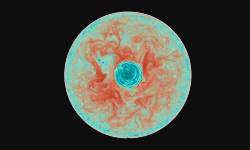 Slice through the simulated interior of a red giant star. Slice through the simulated interior of a red giant star. |
| Supercomputers help solve long-standing astronomy problem |
| Advances in supercomputing have made solving a long-standing astronomy problem possible: How can we explain the changes in the chemical composition at the surface of red giant stars as they evolve? UVic astrophysicists Simon Blouin and Falk Herwig used supercomputers to conduct hydrodynamical simulations and found the answer: stellar rotation increases the mixing rate of materials, helping to connect what’s happening at the centre of the star with the outer connective envelope. |
| LEARN MORE ABOUT RED STARS AND SUPERCOMPUTERS |
|
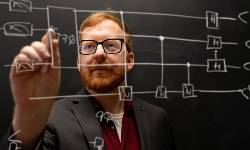 Thomas Baker. Photo credit: UVic Photo Services. Thomas Baker. Photo credit: UVic Photo Services. |
| An introduction to quantum science |
| ‘Quantum’ is one of those words that may feel a bit mysterious if you’re not a quantum scientist. Quantum science studies how the universe behaves at subatomic levels. At that scale, particles act in ways that don’t match our everyday experiences. Scientists explore these unusual behaviours to build new technologies, such as quantum computers, quantum sensors and advanced quantum materials. At UVic, researchers like physicist/chemist Thomas Baker and mathematician Benjamin Anderson-Sackaney are helping build Canada’s quantum expertise. |
| EXPLORE QUANTUM AT UVIC |
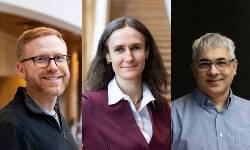 Our three REACH Award winners. Photo credit: UVic Photo Services. Our three REACH Award winners. Photo credit: UVic Photo Services. |
| Recognizing research excellence |
| Three UVic Science researchers have taken home REACH Research Awards this year. Magdalena Bazalova-Carter (PHYS) received the Silver Medal for Excellence in Research, recognizing her expertise in x-ray cancer imaging and radiation therapy, while Greg Owens (BIOL) received the Early Career Award for his work using genomes to understand the past and future of species. Chemist Dennis Hore was recognized with the Research Impact Award for his work pairing advanced spectroscopy with real-world applications in areas such as sustainable materials and drug checking technologies. |
| EXPLORE THE RECIPIENTS |
|
| Science Rendezvous (+ contest alert!) |
| Join us on campus for a day of exploration related to Science, Technology, Engineering and Math—full of fun activities, exciting demos and interesting research. For K-12 students, educators and science enthusiasts of all ages. Before the day comes, make sure you participate in our alumni Science Quiz contest to test your knowledge and win prizes! |
|
|
| Spring Convocation |
| Every year, we celebrate as our students finish their degrees and become new UVic alumni. This year, we’ll be welcoming over 400 new Science graduates to the family. |
|
|
|
Explore the Glover Greenhouse |
Coming this summer, we’re inviting you back to explore the Glover Greenhouse, including the recent 1.25 million in upgrades courtesy of a 2024 CFI grant. Learn about our research in forest biology, meet some of the coolest plants around, get your hands dirty (for real) and connect with other alumni.
Keep an eye out for details in June! |
|
|
|
| Stay connected to the Faculty of Science |
|
If you would like more information on how to get involved as an alumni of the faculty, please contact valeria@uvic.ca.
If you wish to make a gift in support of the Faculty of Science, please contact Kate MacDonald at katemacdonald1@uvic.ca. |
You are receiving this message as a member of the University of Victoria Alumni Association.
Contact us at alumni@uvic.ca |
|
|