| The ethics of AI, how phytoplankton helps us understand climate change and meet the new arrivals to UVic Science |
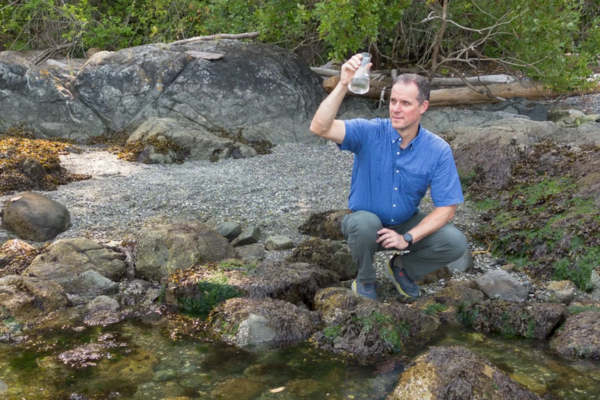 Adrian Marchetti looking at a flask of ocean water. Credit: UVic Photo Services |
| How phytoplankton are helping us understand climate change |
|
UVic’s expertise in phytoplankton and climate change has grown with the recent arrival of biological oceanographer Adrian Marchetti, BC Leadership Chair in Marine Ecosystems and Global Change. Marchetti combines traditional oceanographic methods with advanced methods in molecular biology to study how phytoplankton grow, compete and survive under different environmental conditions. From the West Coast to Antarctica to the Galapagos, Marchetti is helping us better understand how our oceans work and how they are changing.
|
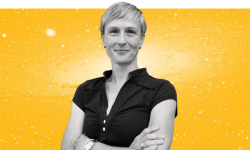 Sara Ellison. Credit: UVic |
| Meet a world leading astrophysicist |
| Astrophysicist Sara Ellison is a world leader in the study of galaxy evolution. She has advanced three distinct fields of astrophysics and her discoveries have opened up major new avenues in galactic chemistry, supermassive black holes and star formation. Ellison was recently elected a fellow of the Royal Society of Canada in recognition of the originality, significance and impact of her work. |
|
EXPLORE THE GALAXIES
|
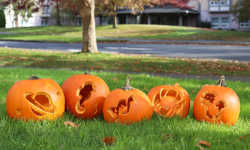 Some science-y pumpkins. |
| Carve a science-themed pumpkin |
| Fall has arrived and Halloween is just around the corner. Have you thought about how you’re going to carve your pumpkin this year? To bring a little bit of science to the season, we’ve put together a little package of science-themed pumpkin carving templates just for you—each with its own science fact contributed by a member of our community. Send us a photo of your carved pumpkin! |
| START PUMPKIN CARVING |
|
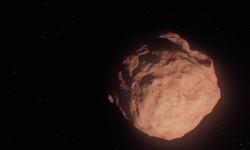 Artist rendering of a TNO. Credit: NASA, ESA, Leah Hustak (STSci) |
| Revealing new clues to planet formation |
| How planets form is an ongoing area of research, and UVic researchers are looking to trans-Neptunian objects (TNOs)—a collection of small icy bodies orbiting the sun beyond Neptune—to make new discoveries. They recently found that different TNO populations share remarkably similar size distributions, despite having different formation locations and histories. This indicates that the conditions during formation do not determine the products. |
| LEARN MORE ABOUT TNOS |
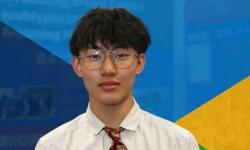 Jason Zhang. Provided |
| Predicting a cancer subtype |
| Inspired by a breast cancer diagnosis in his family, new UVic Science student Jason Zhang took on a science fair project: Using publicly available gene expression data from breast cancer patients, he developed a machine learning model that could predict a patient’s cancer subtype with 93% accuracy. Zhang received a $100,000 Schulich Leader Scholarship to support his studies. |
| MEET OUR 2026 SCHULICH LEADER |
|
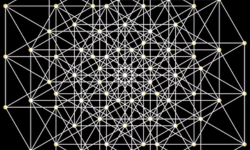 Mathematical idea. Credit: T. Bazett |
| A new golden age of mathematics |
| Recently, there has been steady drumbeat of new results that either partially or completely leverage artificial intelligence to solve research-level mathematics problems. In May 2026, generative AI solved a major unsolved problem known as the “unit conjecture theory”, and even more results have come out since then. In a Conversation Canada article, UVic professor Trefor Bazett tackles the question of where this is going and how AI might impact the field of mathematics. |
| READ THE CONVERSATION PIECE |
 Elliott Hazen. Provided |
| Shifting to proactive marine governance |
| Thanks to an $8 million investment from the federal government, Elliott Hazen will be joining UVic next spring as an Eddie Goldenberg Research Chair. A leader in marine sustainability, Hazen will conduct research aimed at improving climate-ready ocean stewardship. His goal is to shift marine governance from reactive to proactive by identifying early ecosystem warning signals and helping managers anticipate risk and respond in near-real time. |
| MEET ELLIOT HAZEN |
|
| Café Scientifique: How far are we from each other, really? |
Café Scientifique is back for another season! In October, we’ll be exploring “metric spaces”, opening our minds to the many ways we can measure distance that aren’t just “3.5 metres”.
Café Scientifique is a live event with a livestream, and events also take place on Nov. 9 and Dec. 14. |
|
|
| Lipson Lecture: The AI Alignment Problem |
Join us as we explore the ethics of artificial intelligence (AI) with bestselling author and researcher Brian Christian. Who decides which human values and societal norms AI should follow? Should we trust AI with life-and-death decisions? What happens when an AI finds loopholes in the rules? Dive into all these questions and more.
Attend in-person at the Farquhar Auditorium or tune into the alumni livestream. |
|
|
|
| Stay connected to the Faculty of Science |
|
If you would like more information on how to get involved as an alumni of the faculty, please contact valeria@uvic.ca.
If you wish to make a gift in support of the Faculty of Science, please contact Kate MacDonald at katemacdonald1@uvic.ca. |
You are receiving this message as a member of the University of Victoria Alumni Association.
Contact us at alumni@uvic.ca |
|
|